Weather : W - 6, very cold
The Buff bellied Pipit remained at Denhall Lane, Burton until 09.30 only when it was flushed by a Sparrowhawk and not seen for the rest of the day. There is every chance the bird has temporarily move to another part of the marsh and may well return to it's favoured area of tide wrack in due course.
Below is another photograph of Eddie's cracking find.
Photo AEH
Sunday, 22 December 2013
Saturday, 21 December 2013
Buff bellied Pipit
Weather: SW-3, Squally showers. Cold
The 2013 Winter Solstice certainly turned out to be a day to remember on the Wirral. The story however starts some 24 hours earlier on the 20th when Lighthouse Stalwart, Eddie Williams found an interesting pipit on the tide wrack at the bottom of Denhall Lane, Burton. Eddie persisted and eventually managed to obtain some reasonable views that allowed him to identify it as Wirral and Cheshire first BUFF BELLIED PIPIT. Managing to get a few record shots Ed circulated the pictures to us that evening for corroboration.
With Locals on site from dawn today (21st) it wasn't long before we had got our eye in and we were all on the bird quickly. What a bird - Congratulations Eddie.
Below are a selection of shots showing the salient features including. The plain brown mantle with very faint background spotting / lines. Pale Lores. A complete and very obvious eye ring. Small yellow, black tipped bill and as the name suggests a buff wash to the throat and underparts.
All photo's AMC, except No5
The 2013 Winter Solstice certainly turned out to be a day to remember on the Wirral. The story however starts some 24 hours earlier on the 20th when Lighthouse Stalwart, Eddie Williams found an interesting pipit on the tide wrack at the bottom of Denhall Lane, Burton. Eddie persisted and eventually managed to obtain some reasonable views that allowed him to identify it as Wirral and Cheshire first BUFF BELLIED PIPIT. Managing to get a few record shots Ed circulated the pictures to us that evening for corroboration.
With Locals on site from dawn today (21st) it wasn't long before we had got our eye in and we were all on the bird quickly. What a bird - Congratulations Eddie.
Below are a selection of shots showing the salient features including. The plain brown mantle with very faint background spotting / lines. Pale Lores. A complete and very obvious eye ring. Small yellow, black tipped bill and as the name suggests a buff wash to the throat and underparts.
All photo's AMC, except No5
![]() |
| Photo -BSB |
Friday, 13 December 2013
13th December 2013; Chiffchaffs.
Note the all black bill, complete absence of any green or yellow hues on mantle and head, buffy grey mantle, pale buff super and almost white underparts. There is a faint wing bar caused by the pale tips to the greater coverts. The cheeks are also pale buff which reduce the prominence of the eye-ring usually obvious on other races. The rather Bonellis Warbler like contrast between the mantle and the yellow-green colour on the wing and tail can be seen on two of the shots but is not as obvious on he third, although this is the same bird.
4 of the remaining birds appeared to be of the 'common' collybita race while a fifth appeared all grey and could not be assigned to race. Wintering Chiffchaffs are always worth a second look Observers E,W (photos) and K.D.
Monday, 9 December 2013
09 December 2013
Weather; SW - 2, mild and sunny
Following the worst storm surge in the last 50 years, see link for astonishing video http://www.youtube.com/watch?v=BtGxzujen74 , we were able to get out over the last couple of days to assess the damage and look for storm driven seabirds. There was plenty of the former but thankfully few of the latter.
Time today was spent taking some portrait shots of some commoner species however the highlight of today was an unexpected drake GOOSANDER flying west at Walllasey coastguard. Probably the poorest shot of an (in flight, at sea) goosander ever taken but then it was the distance of the wind turbines !
Following the worst storm surge in the last 50 years, see link for astonishing video http://www.youtube.com/watch?v=BtGxzujen74 , we were able to get out over the last couple of days to assess the damage and look for storm driven seabirds. There was plenty of the former but thankfully few of the latter.
Time today was spent taking some portrait shots of some commoner species however the highlight of today was an unexpected drake GOOSANDER flying west at Walllasey coastguard. Probably the poorest shot of an (in flight, at sea) goosander ever taken but then it was the distance of the wind turbines !
![]() |
| A drake Goosander, flying west ! |
Saturday, 30 November 2013
30th November 2013
Thursday, 28 November 2013
28th November 2013
Weather: W - 2, mild and overcast
An adult Mediterranean Gull was on the shore opposite the cafe car park whilst the elusive Kingfisher could be found on the River Birkett, viewed from Lingham Bridge, Lingham Lane.
A small influx of Stonechat included a pair west of Leasowe golf club and another pair on the sea defence at Leasowe Bay.
An adult Mediterranean Gull was on the shore opposite the cafe car park whilst the elusive Kingfisher could be found on the River Birkett, viewed from Lingham Bridge, Lingham Lane.
A small influx of Stonechat included a pair west of Leasowe golf club and another pair on the sea defence at Leasowe Bay.
![]() |
| (AMC) |
Sunday, 24 November 2013
22-24th November 2013
Weather: NE 2 ; Mild and sunny
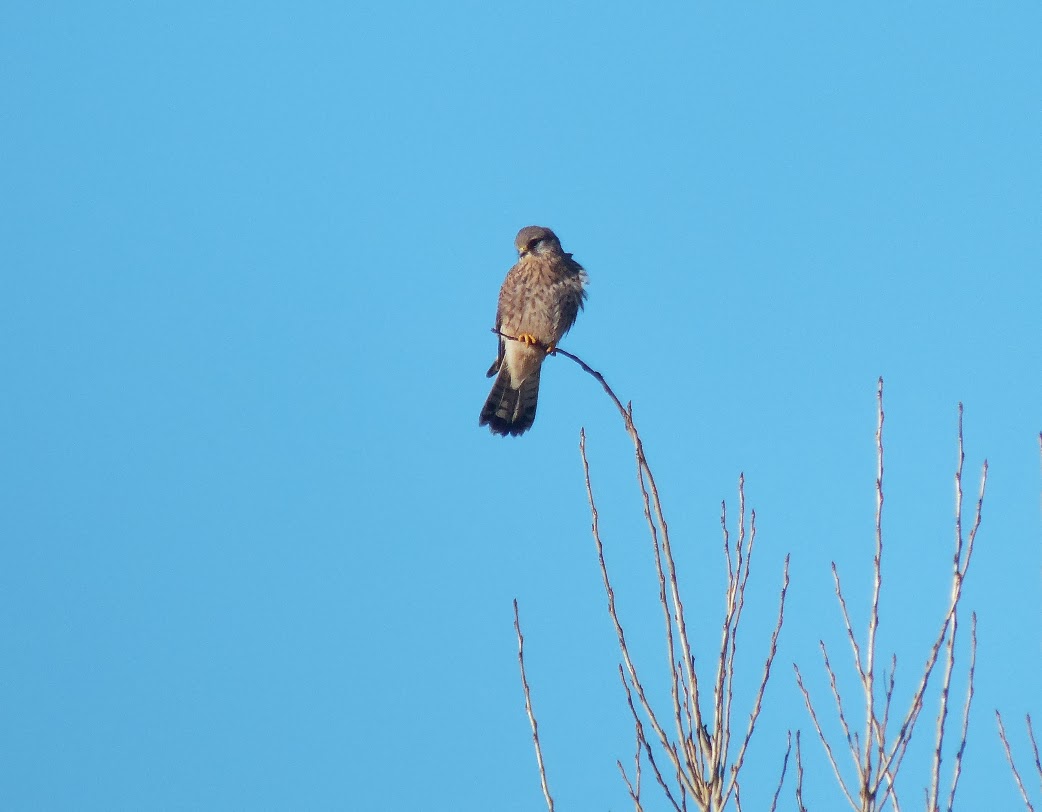
As expected at this time of year, it has been relatively quiet at the Lighthouse of late and there seems to be little doubt all summer migrants have long gone. The resident Kestrel hunts the coastal fields and paddocks which are also used as a high tide roost for up to 50 Curlew.
With a light North easterly prevailing a few finches moved through including, Chaffinch (12), Goldfinch (8), Bullfinch (1) whilst the Linnet flock has somewhat reduced to approximately 30 birds, perhaps moving south for the winter themselves. A number of Reed Bunting are still present including the one below that posed for the camera in the late Autumn sunshine.

As expected at this time of year, it has been relatively quiet at the Lighthouse of late and there seems to be little doubt all summer migrants have long gone. The resident Kestrel hunts the coastal fields and paddocks which are also used as a high tide roost for up to 50 Curlew.
With a light North easterly prevailing a few finches moved through including, Chaffinch (12), Goldfinch (8), Bullfinch (1) whilst the Linnet flock has somewhat reduced to approximately 30 birds, perhaps moving south for the winter themselves. A number of Reed Bunting are still present including the one below that posed for the camera in the late Autumn sunshine.

![]() |
| Black headed Gull well on its way into summer plumage |
Subscribe to:
Posts (Atom)


.bmp)
.bmp)